Advanced Aesthetics for Skin: A Complete Clinical Guide

Table of Contents
What Advanced Aesthetics and Clinical Skincare Actually Are
The Synergy Between Clinical Skincare and Professional Aesthetic Procedures
Ingredient Compatibility: What to Pause and What to Introduce
Why Timing Matters: The Mechanism
Common Mistakes That Derail Results
Non-Invasive vs. Minimally Invasive Techniques: Which Approach Fits Your Goals
Laser Facial Near Me: Finding Professional Skin Assessment and Treatment
Clinical Skincare for Hyperpigmentation and Uneven Skin Tone
Advanced Aesthetic Treatment Recovery Time and Post-Procedure Skincare Maintenance
Tailoring Treatments to Your Skin Type and Personalized Care Plans
Long-Term ROI, Maintenance Schedules, and Psychological Impact of Aesthetic Enhancement
Building a Realistic Maintenance Roadmap
Why Maintenance Frequency Matters
The Psychological Impact: Beyond Skin
Calculating Your Actual ROI
Setting Expectations: The Reality Conversation
The Long-Term Commitment Mindset
Frequently Asked Questions
Last Updated: September 23, 2026
What Advanced Aesthetics and Clinical Skincare Actually Are
Advanced aesthetics clinical skincare integrates professional-grade products with minimally invasive or non-invasive procedures to improve skin appearance. Unlike over-the-counter skincare alone, this approach combines medical-grade topical treatments with procedures targeting deeper dermal layers to address aging, pigmentation, texture, and overall skin health.
Clinical skincare operates under dermatological standards with higher concentrations of active ingredients, retinoids, peptides, antioxidants, hydrating compounds, formulated to penetrate the epidermal barrier. Paired with procedures like laser therapy, chemical peels, or microneedling, they create synergistic effects that amplify results beyond either approach alone.
At PINK MINK NYC, clients benefit from personalized care designed to help them look and feel their personal best.
Advanced aesthetics for clinical skincare works best when tailored to your specific skin type, concerns, and maintenance expectations, requiring professional assessment and ongoing adjustment rather than one-size-fits-all protocols.
The Synergy Between Clinical Skincare and Professional Aesthetic Procedures
Professional aesthetic procedures create controlled injury to stimulate collagen production and cellular renewal. Chemical peels remove damaged epidermal layers, laser therapy targets pigmentation, and microneedling triggers healing responses. Each demands proper pre-procedure preparation and post-procedure support.
Clinical skincare is essential pre-procedure: the ingredients you use before directly affect healing outcomes, complication risk, and final results, yet most guides skip this.
Ingredient Compatibility: What to Pause and What to Introduce
Before procedures (typically 1-2 weeks prior):
Retinoids (retinol, retinaldehyde, tretinoin) should be paused 5-7 days before procedures. They increase cell turnover and thin the stratum corneum, compromising barrier integrity. Reintroducing them too soon post-procedure causes irritation, prolonged inflammation, and hyperpigmentation risk, especially on darker skin tones.
Hydroxy acids (AHAs, BHAs) should be discontinued 3-5 days before procedures. Combined with procedure-induced trauma, they elevate burn risk and slow healing.
Vitamin C serums and other antioxidants should continue through the pre-procedure window. These protect against oxidative stress and actually reduce inflammation risk during healing. High-potency vitamin C (10-20% L-ascorbic acid) is particularly valuable pre-procedure.
Peptides and growth factors should be introduced or increased 1-2 weeks before procedures. Studies show peptide-rich formulations accelerate collagen synthesis and reduce recovery time when applied consistently before trauma.
Barrier-support ingredients (ceramides, cholesterol, free fatty acids in a 3:1:1 ratio) should be emphasized the week before procedures, as compromised barriers heal slower and risk infection and irritation.
Immediately after procedures (Days 1-3):
The first 72 hours are non-negotiable. Your skin's barrier is disrupted. Avoid all actives: no retinoids, no acids, no vitamin C, no essential oils, no fragrance. This is when barrier-repair moisturizers with ceramides, peptides, and hyaluronic acid become your entire routine.
Growth factors and peptides accelerate healing during this window. Formulations containing EGF (epidermal growth factor) or FGF (fibroblast growth factor) analogs reduce inflammation and speed barrier restoration. This is not luxury, it's mechanism-based recovery support.
Days 4-7 post-procedure:
If your skin tolerates it, gentle antioxidants (vitamin E, ferulic acid) can be reintroduced to support ongoing healing without irritation. Avoid actives still.
Weeks 2-4 post-procedure:
Retinoids can be reintroduced cautiously, starting at the lowest concentration (0.025% tretinoin or equivalent) 2-3 times weekly. Increase frequency only if no irritation develops. Hydroxy acids should wait until week 3-4, and only if the skin shows no residual sensitivity.
Antioxidants and peptides should continue throughout recovery and beyond.
Why Timing Matters: The Mechanism
Healing follows a predictable timeline: Days 1-3 (inflammatory phase) flood the area with immune cells and growth factors, introducing irritating actives hijacks healing resources. Days 4-7 (proliferative phase) are when fibroblasts actively produce collagen and peptides have maximum impact. Weeks 2-4 (remodeling phase) organize and strengthen collagen; gentle actives support this without disrupting it.
Following ingredient timing protocols can support healing and optimize results.
Common Mistakes That Derail Results
Starting retinoids too early: Prolongs redness, peeling, and hyperpigmentation (recovery extends to 4-6 weeks).
Continuing acids through the procedure window: Increases burn depth and doubles healing time.
Skipping barrier support: Risks infection, prolonged inflammation, and post-inflammatory hyperpigmentation, especially on melanated skin.
Using incompatible products: Ask your provider which specific products support your treatment, not just which category.
Your aesthetic professional should always specify which products support your specific treatment and recovery timeline, and crucially, which ingredients to pause before your appointment.
Non-Invasive vs. Minimally Invasive Techniques: Which Approach Fits Your Goals
Non-invasive techniques (topical treatments, light therapy, certain lasers) require no downtime and work gradually over weeks or months, ideal for maintenance, prevention, and mild concerns. Minimally invasive procedures (chemical peels, microneedling, laser resurfacing) produce faster, dramatic results but require recovery time and carry higher risks.
Non-invasive options work best for:
Preventative skincare and maintenance
Mild pigmentation or texture concerns
Patients unable to take downtime
Those building toward more aggressive treatment
Minimally invasive options suit:
Significant wrinkles, laxity, or scarring
Advanced photodamage or pigmentation
Patients willing to accept 3-7 days recovery
Those seeking dramatic, visible results within weeks
Laser Facial Near Me: Finding Professional Skin Assessment and Treatment
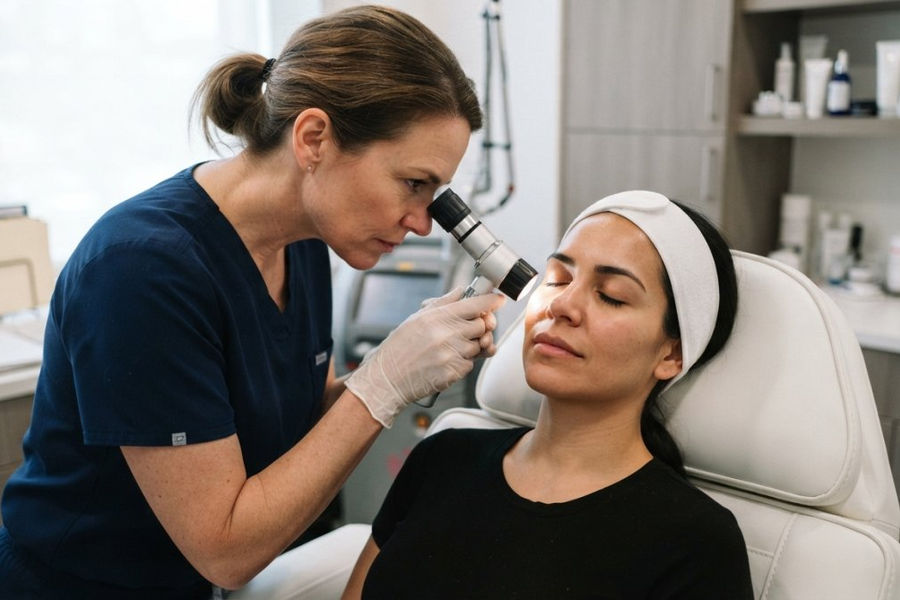
Credentials matter: laser therapy demands training. Look for practitioners with dermatology backgrounds or board certification in aesthetic medicine. Wrong technique or settings can cause burns, scarring, or permanent pigmentation changes, especially on melanated skin.
Clinical Skincare for Hyperpigmentation and Uneven Skin Tone
Hyperpigmentation, melasma, and post-inflammatory discoloration respond well to combined clinical skincare and professional treatment. Many pigmentation treatments irritate or damage melanated skin, making professional guidance essential.
Advanced Aesthetic Treatment Recovery Time and Post-Procedure Skincare Maintenance
Recovery varies by intensity: non-invasive lasers cause mild redness for hours; chemical peels require 3-7 days of visible peeling; aggressive microneedling or fractional laser resurfacing requires 5-10 days.
Tailoring Treatments to Your Skin Type and Personalized Care Plans
Long-Term ROI, Maintenance Schedules, and Psychological Impact of Aesthetic Enhancement
Advanced aesthetics for clinical skincare is a long-term commitment. Understanding the commitment required to sustain results is important.
Building a Realistic Maintenance Roadmap
Mild aging and prevention (Fitzpatrick I-III): Monthly treatments for 3 months, then quarterly indefinitely. Home care: daily clinical skincare. Annual cost: $1,800-$3,600. Results visible in 6-8 weeks; plateau at 12-16 weeks.
Why Maintenance Frequency Matters
Skip maintenance, and results regress. Collagen degrades continuously, your body breaks down more collagen than it produces after age 25, at a rate of roughly 1% per year. Professional treatments stimulate new collagen, but that collagen also degrades. Quarterly maintenance prevents regression by continuously restimulating collagen production before visible decline occurs.
The Psychological Impact: Beyond Skin
Visible skin improvement correlates strongly with improved self-perception and reduced appearance anxiety. Research on cosmetic procedures consistently shows that patients report:
Increased confidence in social and professional settings
Reduced appearance-related anxiety and rumination (measurable decrease in appearance-focused repetitive thoughts)
Improved quality of life metrics, including social engagement and willingness to be photographed
Better mood and reduced depression symptoms in patients with appearance-related distress
Calculating Your Actual ROI
Financial: Most patients find $150-$400 monthly reasonable for professional skin health, compared to dermatology visits for skin conditions or corrective procedures later.
Setting Expectations: The Reality Conversation
Before committing to treatment, have this conversation with your aesthetic provider:
What is my realistic starting point? (Professional assessment of your current skin condition)
What results can I expect in 8 weeks? 16 weeks? 6 months? (Specific, measurable outcomes tied to your concerns)
What does maintenance look like long-term? (Frequency, cost, time commitment)
What happens if I stop treatment? (Timeline and degree of regression)
What are the risks specific to my skin type? (Especially important for melanated skin, which faces higher hyperpigmentation and scarring risk with improper technique)
How will we measure progress? (Baseline photos, objective metrics, not just subjective feeling)
The Long-Term Commitment Mindset
Advanced aesthetics for clinical skincare works best when you shift from "fixing" your skin to "maintaining" it. This mindset change is crucial. You're not trying to achieve perfection and stop. You're trying to sustain improvement indefinitely, the way you maintain fitness or dental health.
Frequently Asked Questions
What does advanced aesthetics include in a clinical setting?
Advanced aesthetics in a clinical setting combines medical-grade skincare with professional procedures like laser therapy, chemical peels, and injectables, all performed under physician oversight. These treatments target skin rejuvenation, collagen production, and correction of pigmentation and fine lines. Unlike spa facials, clinical aesthetics follow strict dermatological standards and are customized based on professional skin analysis and your specific skin type.
How do clinical skincare treatments differ from standard spa facials?
Clinical skincare uses medical-grade ingredients and equipment designed to penetrate the dermal layers and create measurable cellular turnover. Spa facials focus on surface cleansing and hydration. Clinical treatments address specific concerns like hyperpigmentation, acne, and skin laxity with proven treatment efficacy, while spa facials provide relaxation and basic maintenance. Clinical skincare is typically prescribed as part of a comprehensive aesthetic plan.
How do you determine the right aesthetic treatment for your Fitzpatrick skin type?
Professional skin assessment is essential. A qualified provider evaluates your Fitzpatrick classification, skin texture, tone, and specific concerns like acne or hyperpigmentation. Certain procedures work better on specific skin types, for example, laser wavelengths must be adjusted for melanated skin to ensure patient safety and prevent discoloration. Personalized care plans account for your skin's unique characteristics and aesthetic goals.
What role does medical oversight play in advanced aesthetic procedures?
Physician oversight ensures procedures follow clinical standards, proper technique, and appropriate aftercare protocols. A qualified provider can assess your medical history, identify contraindications, and adjust treatment intensity based on your skin's response. Medical-grade equipment and professional administration significantly reduce risks of adverse reactions and improve treatment outcomes compared to non-medical settings.
What is the typical recovery time after advanced aesthetic treatments?
Recovery varies by procedure. Non-invasive treatments like topical applications have minimal downtime. Minimally invasive procedures like laser therapy or chemical peels may cause redness or mild irritation lasting 24-48 hours. More intensive treatments may require 3-7 days of post-procedure skincare maintenance. Your provider will outline specific recovery expectations and aftercare instructions to support skin healing and collagen production.
How often do I need aesthetic treatments to see lasting results?
Results depend on your treatment plan and skin concerns. Clients may see improvement after a series of treatments spaced weeks apart. Maintenance schedules vary: some procedures require quarterly touch-ups, while clinical skincare routines provide ongoing support between professional treatments. Long-term success combines professional procedures with consistent at-home clinical skincare and preventative skincare practices.
BOOK NOW


Comments