How to Choose a Dermatologist for Ethnic Skin

Table of Contents
Why Ethnic Skin Needs a Different ApproachThe Science Behind Melanin and Skin ConditionsCommon Conditions in Skin of Color
The Science Behind Melanin and Skin Conditions
Common Conditions in Skin of Color
How to Find a Board-Certified DermatologistVerifying Credentials and Training
Verifying Credentials and Training
Using the Fitzpatrick Skin Type Chart to Guide Your Search
Questions to Ask a Dermatologist Before Laser TreatmentTechnology and Device SafetyWhat to Ask for as Proof of Experience
Technology and Device Safety
What to Ask for as Proof of Experience
Red Flags in a Dermatology Consultation
Insurance, Accessibility, and Patient AdvocacyWhat Is Usually Covered vs. What Usually Is NotHow to Navigate Coverage Before You BookAccessibility: Telehealth, Sliding Scale, and Clinical TrialsAdvocating for Yourself in the Room
What Is Usually Covered vs. What Usually Is Not
How to Navigate Coverage Before You Book
Accessibility: Telehealth, Sliding Scale, and Clinical Trials
Advocating for Yourself in the Room
Conclusion
Frequently Asked Questions
Last Updated: September 12, 2026
Why Ethnic Skin Needs a Different Approach
Finding a dermatologist who truly understands melanin-rich skin is not a matter of preference. It is a matter of getting accurate care. This guide from PINK MINK NYC explains how to choose a dermatologist for ethnic skin, because the stakes are higher than most people realize. Skin of color has a different structural and biological profile, and that difference changes how conditions present, how they heal, and which treatments are safe.
Ethnic skin refers to skin with higher concentrations of melanin, typically classified as Fitzpatrick types IV, V, and VI, which responds differently to inflammation, injury, and energy-based treatments than lighter skin. The melanocytes that give skin its color also make it more prone to certain reactions.
The Science Behind Melanin and Skin Conditions
Melanin protects against UV damage, but it also complicates diagnosis and treatment. When skin of color becomes inflamed, the melanocytes can overreact and produce excess pigment. That is why a condition as ordinary as a pimple can leave a dark mark lasting months. The same mechanism makes aggressive laser settings dangerous: too much heat triggers the very discoloration patients are trying to avoid.
Common Conditions in Skin of Color
Dermatologic conditions in darker skin tones often look different from textbook photos. A common mistake is assuming a rash or patch is harmless because it does not appear red. In practice, conditions like acne, keloids, melasma, and post-inflammatory hyperpigmentation can present in ways that less experienced providers misread.
Acne and post-inflammatory hyperpigmentation: Dark spots that outlast the acne itself
Keloids: Raised scars that form after injury or piercing
Melasma: Patchy darkening, often triggered by hormones or sun
Follicular conditions: Bumps and ingrown hairs common in coarser hair types
American Academy of Dermatology on skin of color maintains patient resources confirming these conditions require tailored care.
How to Find a Board-Certified Dermatologist
The fastest way to find a board-certified dermatologist is to verify certification through the American Board of Dermatology, then confirm the provider's experience with your specific skin type. Certification is the floor, not the ceiling.
Verifying Credentials and Training
A board-certified dermatologist has completed a dermatology residency and passed rigorous examinations, earning the FAAD designation. That training covers medical dermatology, cosmetic dermatology, and dermatologic surgery. What most guides miss is that certification alone does not guarantee comfort with skin of color. Ask directly how much of their practice involves Fitzpatrick types IV through VI.
Pro Tip Check the provider's bio for terms like "skin of color," "melanin-rich," or "Fitzpatrick IV-VI." A dermatologist who tracks this in their own marketing usually sees these patients regularly.
Using the Fitzpatrick Skin Type Chart to Guide Your Search
The Fitzpatrick skin type chart classifies skin on a scale from I to VI based on how it responds to UV exposure, and it is the single most useful tool for matching yourself with the right provider. Types I and II burn easily and rarely tan. Types V and VI rarely burn and tan deeply. Most laser safety decisions hinge on where you fall on this scale.
Fitzpatrick Type | Typical Description | Laser Consideration |
I-II | Fair, burns easily | Lower risk, standard settings |
III | Medium, sometimes burns | Moderate caution |
IV | Olive to light brown | Needs wavelength selection |
V-VI | Brown to deep brown | Requires specialized devices |
A dermatologist who cannot explain which devices suit your type is a red flag. Ask them to walk you through the reasoning.
Questions to Ask a Dermatologist Before Laser Treatment
The right questions before laser treatment cover device type, wavelength, settings, test spots, and aftercare, and any provider who cannot answer them clearly is not the right fit. Bring this list to your consultation, and write down the answers so you can compare providers.
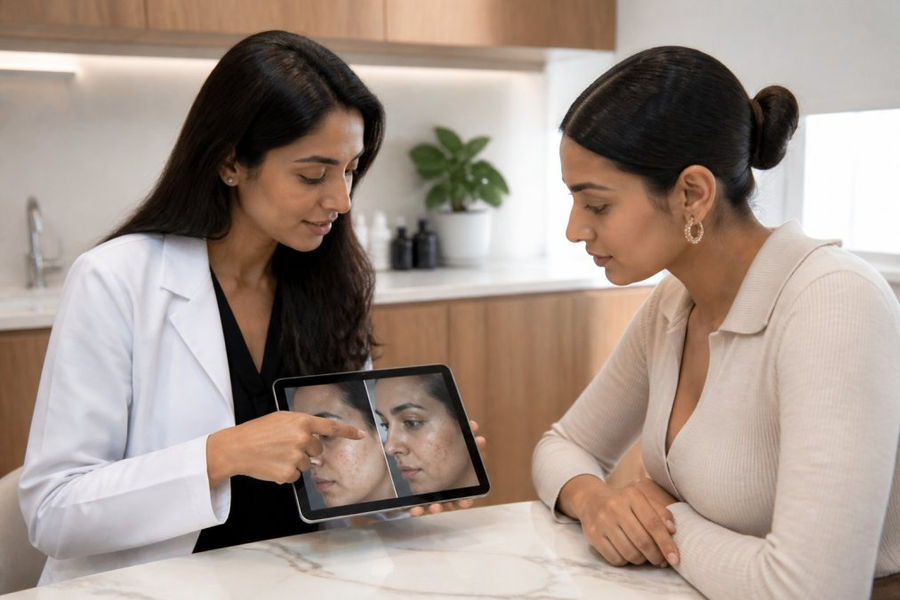
Which specific device and wavelength will you use, and why is it appropriate for my Fitzpatrick type?
Will you perform a test spot before treating my full face or body, and how long will we wait before judging the result?
How do you adjust fluence, pulse duration, and cooling for darker skin tones to reduce burn and discoloration risk?
How many patients with Fitzpatrick type V or VI have you treated with this exact device in the past year?
What is your protocol if I develop post-inflammatory hyperpigmentation or a burn, who manages it, and at what cost?
Which medications, supplements, or recent sun exposure would make you postpone treatment?
What results should I realistically expect, how many sessions will I need, and what is the total cost per session?
Who actually operates the device, you, a nurse, or an esthetician, and what is their training and supervision?
Technology and Device Safety
Not all lasers are safe for all skin, and the difference is not marketing, it is physics. Melanin absorbs light across a broad spectrum, so in darker skin the target chromophore (hair, pigment, blood vessel) competes with the surrounding epidermis for that energy. When a device's wavelength is too short or the pulse is too long, the epidermis heats up and you get the exact outcome you were trying to avoid: burns, blistering, and post-inflammatory hyperpigmentation.
A few practical rules most experienced providers follow:
Longer wavelengths penetrate deeper with less epidermal absorption. Devices in the 755 nm alexandrite, 1064 nm Nd:YAG, and 1064/532 nm combination ranges are commonly used for higher Fitzpatrick types, while shorter-wavelength options carry more risk.
Longer pulse durations and aggressive cooling give the epidermis time to shed heat. A provider who cannot explain pulse duration is a provider who does not understand your skin.
Test spots are not optional. A small, hidden-area test spot read at one to two weeks is the standard way to confirm a device and setting are safe before committing to a full treatment.
Some technologies are simply the wrong tool. Certain IPL devices, older resurfacing lasers, and aggressive chemical peels have a well-documented history of causing hypopigmentation and scarring in darker skin. A provider who recommends them without discussing that history is not current.
The U.S. Food and Drug Administration guidance on laser products notes that laser devices carry real risks, including burns and changes in skin color, which is why operator training matters as much as the machine itself. The FDA clears devices for specific indications, not for specific skin types, so 'FDA-cleared' does not mean 'safe for Fitzpatrick VI.' That judgment belongs to the clinician.
Watch Out A provider who promises permanent hair removal in one session, who dismisses your concerns about discoloration, or who cannot name the wavelength of their device is minimizing real risks. Walk away.
What to Ask for as Proof of Experience
Experience claims are easy to make and hard to verify. Ask for specifics you can check:
Case photos of patients with your skin tone and your condition, taken before and after with consistent lighting. A provider who treats skin of color regularly will have these on hand.
The name of the device and its manufacturer, so you can look up its indications and read the user manual's skin-type warnings yourself.
A written treatment plan that lists the device, settings range, number of sessions, expected downtime, and the cost of treating any complication.
A provider who welcomes these requests is showing you exactly the kind of patient-centered care you want. A provider who deflects them is telling you something too.
Red Flags in a Dermatology Consultation
Certain warning signs should end a consultation early, regardless of how impressive the office looks. Watch for these during your visit:
Rushing you past your questions or refusing to discuss device settings
Claiming a treatment is completely risk-free or painless
No interest in your medical history, medications, or hormonal conditions
Pressure to book and pay before you have had a chance to think
No clear answer about who performs the procedure and their training
A provider who welcomes questions and explains trade-offs is showing you exactly the kind of patient-centered care you want.
Insurance, Accessibility, and Patient Advocacy
Insurance coverage for dermatologic care varies widely, and the single most useful thing you can do before booking is figure out which side of the medical-versus-cosmetic line your concern falls on. That line determines whether you pay a copay or the full retail price.
What Is Usually Covered vs. What Usually Is Not
Typically covered as medical dermatology when there is a documented diagnosis and symptoms:
Moderate to severe acne, including hormonal acne and acne causing scarring or pigmentary change
Hidradenitis suppurativa (HS), including biologics and in-office drainage
Keloids and hypertrophic scars that are symptomatic or restricting movement
Melasma when it is being managed as a medical condition rather than a cosmetic concern
Skin cancer screening and biopsy, including acral lentiginous melanoma evaluation
Alopecia areata, including intralesional steroid injections
Typically not covered because they are considered cosmetic:
Laser hair removal for non-medical reasons
Elective laser resurfacing, IPL, and most pigment lasers for cosmetic improvement
Cosmetic injectables and fillers
Most chemical peels performed for appearance rather than a diagnosed condition
There is a middle category worth knowing: a treatment can be covered when it is documented as medically necessary. Laser hair removal for severe pseudofolliculitis barbae, or for hidradenitis suppurativa, is sometimes approved when the chart reflects recurrent infection, pain, or scarring. The diagnosis code and the documentation do the work, not the device.
How to Navigate Coverage Before You Book
Call your insurer first and ask three questions: Is this provider in network? Is the specific diagnosis covered? Is prior authorization required for the treatment?
Ask the office for the procedure and diagnosis codes they plan to submit, then read them back to your insurer. This is the fastest way to avoid a surprise bill.
Request a predetermination or prior authorization in writing for anything expensive. Keep the reference number.
Ask about the out-of-network and self-pay rates in the same call. Many practices offer a cash price that is lower than the out-of-network billed rate.
If a claim is denied, appeal it. Denials are frequently overturned when the chart documents medical necessity, failed prior treatments, and symptom severity. Ask your dermatologist's office to send a letter of medical necessity.
Pro Tip Ask the front desk: 'If my insurer denies this, what is your self-pay price, and do you offer a payment plan?' Getting that number in writing before treatment prevents the most common billing surprise in dermatology.
Accessibility: Telehealth, Sliding Scale, and Clinical Trials
Access to a dermatologist who understands skin of color is uneven, and cost is only one barrier. A few practical routes:
Telehealth has expanded dermatology access significantly and is often covered at a lower copay than in-person visits. It works well for acne, eczema, melasma management, and follow-ups, though it cannot replace an in-person exam for a suspicious lesion or a procedure.
Academic medical centers frequently have dermatology residents and attendings with dedicated skin-of-color clinics, and they often accept Medicaid and offer sliding-scale fees.
Community health centers and federally qualified health centers provide dermatology services on a sliding scale based on income.
Clinical trials for conditions like HS, vitiligo, and melasma sometimes cover the cost of treatment and monitoring. Ask your dermatologist whether any are enrolling, or search ClinicalTrials.gov by condition.
Advocating for Yourself in the Room
Patient advocacy is not confrontation, it is preparation. A few scripts that work:
"I have [condition] and I'm concerned about post-inflammatory hyperpigmentation. Can you walk me through how your plan accounts for that?"
"Can you show me before-and-after photos of patients with my skin tone who had this treatment?"
"If this doesn't work, what is the next step, and is it covered by my insurance?"
"I'd like a copy of my treatment plan and the diagnosis codes in writing."
National Institutes of Health resources on health equity highlight that health equity in dermatology remains an ongoing effort, and you have every right to seek a provider who takes your concerns seriously, and to switch if the first one does not.
Key Takeaway The best dermatologist for ethnic skin combines board certification, hands-on experience with Fitzpatrick types IV-VI, and a willingness to answer every question without defensiveness, and the right one will also help you navigate the insurance maze instead of leaving you to figure it out alone.
Conclusion
Choosing the right dermatologist for melanated skin takes a little homework, but it protects your skin from avoidable damage. At PINK MINK NYC, our team specializes in treatments tailored to individual Fitzpatrick skin types, with a dedicated focus on PCOS, HS, and melanated skin. Led by Dr. Syed, we utilize groundbreaking techniques tailored to individual Fitzpatrick skin types, with a dedicated focus on PCOS/PMOS, HS and melanated skin. Clients benefit from a fast, pain free experience backed by a lifetime satisfaction guarantee. If you want expert-led care designed for your skin, book a consultation and get started with PINK MINK NYC.
Frequently Asked Questions
What is a red flag in dermatology when choosing a provider for ethnic skin?
A major red flag is a provider who dismisses your concerns about darker skin tones or claims that laser and other treatments work the same for everyone. Other warnings include refusing to discuss your Fitzpatrick skin type, lacking specific training in skin of color, or promising permanent results without a consultation. If a dermatologist cannot explain how melanin-rich skin responds differently to treatments, seek a second opinion.
How can I verify a dermatologist's experience with diverse skin tones?
Ask directly about their training in skin of color, including residency exposure and continuing education. Check if they are a Fellow of the American Academy of Dermatology (FAAD) and whether they have published or presented on conditions like keloids, melasma, or post-inflammatory hyperpigmentation. You can also request before-and-after photos of patients with similar Fitzpatrick skin types to yours, ideally from the last year.
Why is the Fitzpatrick skin type chart important when choosing a dermatologist?
The Fitzpatrick skin type chart classifies skin by how much melanin it produces and how it responds to UV exposure. Types IV through VI have a higher risk of hyperpigmentation, keloids, and laser-induced burns if the wrong device or settings are used. A dermatologist who routinely references the Fitzpatrick scale when planning treatments is more likely to adjust laser wavelengths and energy levels safely for your skin.
What questions should I ask a dermatologist before laser treatment for ethnic skin?
Ask which laser devices they use and whether those devices are cleared by the FDA for your Fitzpatrick skin type. Inquire about the practitioner's specific experience treating darker skin tones and how they prevent burns or post-inflammatory hyperpigmentation. Also ask about aftercare, how many sessions you may need, and what happens if you experience an adverse reaction. A provider who welcomes these questions is a good sign.
BOOK NOW


Comments