Vitamin C for Dark Skin Hyperpigmentation: Benefits

Table of Contents
Why Dark Skin Needs a Different Vitamin C Approach
Top Benefits of Vitamin C for Dark Skin Hyperpigmentation
Choosing a Vitamin C Serum for Hyperpigmentation
How to Use Vitamin C for Dark Spots and Melasma
Vitamin C Side Effects on Dark Skin and How to Prevent Them
PIH vs. Melasma: What Vitamin C Can and Cannot Do
Layering Vitamin C with Other Pigment Fighters
The Bottom Line on Vitamin C for Melanin-Rich Skin
Frequently Asked Questions
Last Updated: September 9, 2026
Why Dark Skin Needs a Different Vitamin C Approach
Hyperpigmentation in melanin-rich skin is a distinct challenge because the skin produces more melanin and responds to inflammation with excess pigment. The benefits of vitamin c dark skin hyperpigmentation go beyond simple brightening, but the approach must respect a lower irritation threshold.
Most guides treat Vitamin C as a one-size-fits-all antioxidant. That misses the core issue: darker skin types are prone to post-inflammatory hyperpigmentation (PIH), so any irritation from a poorly formulated serum can create new dark spots.
Top Benefits of Vitamin C for Dark Skin Hyperpigmentation
Vitamin C is a tyrosinase inhibitor that interrupts melanin production at the source, which is why it is a cornerstone treatment for dark spots and uneven tone. It blocks the enzymatic step where melanocytes convert tyrosine into pigment, reducing new dark patches while other agents fade existing ones.
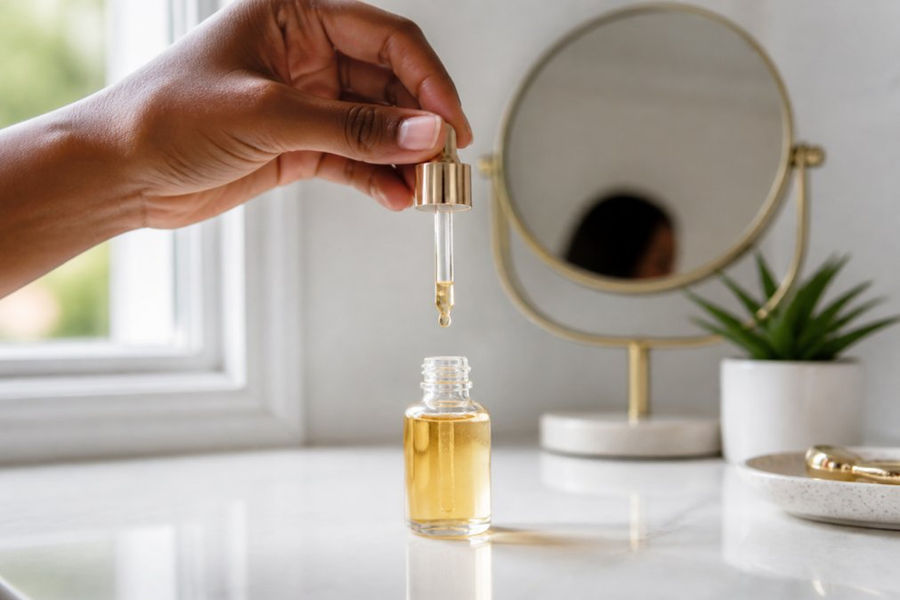
The clinical benefits for melanin-rich skin are well documented:
Dark spot reduction: Consistent use fades existing hyperpigmentation by disrupting melanin synthesis.
Even skin tone: It corrects pigment distribution, addressing the dull and grey complexion often reported in darker skin.
Collagen synthesis: Vitamin C is a required cofactor for collagen production, improving skin texture refinement and dermal health.
Photoprotection: As a topical antioxidant, it neutralizes free radicals from UV exposure, which otherwise trigger new melanin production.
Skin resilience: It strengthens the skin barrier function, helping the skin recover from procedures without developing PIH.
These benefits depend entirely on a formulation that does not cause irritation; an unstable serum that oxidizes can do more harm than good.
Choosing a Vitamin C Serum for Hyperpigmentation
Choosing a Vitamin C serum for hyperpigmentation on vitamin c dark skin comes down to the form of Vitamin C, its concentration, its pH, and a fourth factor most guides skip: formulation stability. An unstable serum does not just lose potency, it degrades into compounds that can sensitize the skin and trigger the inflammatory response that leads to PIH.
L-ascorbic acid is the most studied and effective depigmenting agent, working by directly inhibiting tyrosinase. However, it is also the most irritating and least stable. For darker skin, a concentration between 10% and 15% is generally the sweet spot; above 15% increases irritation risk without proportional benefit, a 2013 study in the Journal of Clinical and Aesthetic Dermatology found 15% no more effective than 10% for photodamage while being significantly more irritating. It works best at a pH below 3.5, but that acidity can sting on sensitive, melanin-rich skin.
L-ascorbic acid is water-soluble and oxidizes rapidly when exposed to air, light, and heat, forming dehydroascorbic acid, which loses depigmenting power and can act as a pro-oxidant. For dark skin, applying an oxidized serum is arguably worse than using nothing.
Watch Out A common mistake is buying a serum that has oxidized. If your Vitamin C turns a deep amber or brown color, it is no longer effective and can actually sensitize the skin. Buy small bottles and store them away from light and heat. Look for opaque, airless pumps rather than dropper bottles.
Tetrahexyldecyl ascorbate (THD ascorbate) is the standout derivative for melanin-rich skin. Unlike L-ascorbic acid, it is oil-soluble, penetrating the lipid-rich stratum corneum more easily and reaching melanocytes without needing a low pH, and it does not oxidize on exposure to air. A 2013 study in the Journal of Drugs in Dermatology found that 10% THD ascorbate significantly reduced hyperpigmentation and improved skin tone over 12 weeks with minimal irritation, making it often the better first-line choice for darker skin prone to stinging (PubMed).
Other derivatives include magnesium ascorbyl phosphate (MAP) and sodium ascorbyl phosphate (SAP). Both are water-soluble, stable, and gentler than L-ascorbic acid. MAP inhibits melanin synthesis in vitro but is less potent than L-ascorbic acid at equivalent concentrations. SAP has additional anti-acne properties, useful for those with breakouts that could lead to PIH. Derivatives are less potent per molecule, but stable enough to remain active on the shelf and gentle enough for consistent use.
A practical decision tree for darker skin:
If you have never used Vitamin C and have sensitive skin: Start with a 10% THD ascorbate serum. It is stable, non-irritating, and effective.
If you tolerate acids well and want maximum potency: Use a 10% to 15% L-ascorbic acid serum with a pH between 3.0 and 3.5. Check the formulation date and finish the bottle within three months.
If you have active acne and PIH: Consider a sodium ascorbyl phosphate serum, which addresses both pigment and breakouts.
If you are on a budget: MAP-based serums are often more affordable than THD ascorbate and still deliver visible results over 8 to 12 weeks.
Pro Tip When reading labels, look for "water-free" or "anhydrous" formulations of L-ascorbic acid. These suspend the molecule in a non-aqueous base, significantly slowing oxidation. Some brands also use ferulic acid and vitamin E in the same formula, which stabilize L-ascorbic acid and boost its photoprotective effect by up to eight-fold.
For melanin-rich skin, the gentlest effective form of Vitamin C is the one used daily. A 10% THD ascorbate serum used every morning will outperform a 15% L-ascorbic acid serum that stings, oxidizes, and gets abandoned by week three.
How to Use Vitamin C for Dark Spots and Melasma
To get the benefits of vitamin c for dark skin hyperpigmentation, how you apply it matters as much as what you apply. The product works best on clean, dry skin.
Morning application: Apply Vitamin C before sunscreen. It boosts photoprotection and neutralizes oxidative stress from UV exposure throughout the day.
Wait time: After cleansing, wait 60 seconds for the skin to dry before applying the serum to prevent stinging.
Amount: Three to four drops pressed gently into the skin, not rubbed aggressively. Friction itself can trigger PIH in melanin-rich skin.
Moisturizer: Follow with a moisturizer to support skin barrier function and lock in the serum.
Sunscreen is non-negotiable: Without daily SPF, Vitamin C cannot outpace the new pigment generated by UV exposure.
Pro Tip Start with application every other day for two weeks. This lets your skin build tolerance. If you experience no stinging or redness, move to daily use. This ramp-up period is the single most effective way to avoid the irritation that leads to PIH.
Consistency over months, not weeks, is what produces visible dark spot reduction. Most dermatological efficacy studies track results over 8 to 12 weeks of daily use.
Vitamin C Side Effects on Dark Skin and How to Prevent Them
Vitamin C side effects on dark skin are real but largely preventable. The primary concerns are stinging, redness, and the paradoxical development of new hyperpigmentation from irritation.
The irritation threshold is lower in melanin-rich skin because inflammation triggers melanocytes to produce more pigment. When a serum causes contact dermatitis or stinging, the aftermath can be a darker patch than the original spot. Formulation stability and concentration are not nerdy details, they are safety requirements.
To prevent side effects:
Patch test behind the ear for five days before applying to the face.
Avoid using Vitamin C on the same day as retinoids or exfoliating acids like glycolic acid, which lower the irritation threshold.
If stinging occurs, wash off immediately and dilute the serum with your moisturizer on the next attempt.
During the adjustment period, skip active treatments and use only a gentle cleanser and moisturizer.
Key Takeaway If a Vitamin C product burns or leaves your skin red, stop using it. Pushing through the discomfort on dark skin is how you trade one dark spot for a larger one.
PIH vs. Melasma: What Vitamin C Can and Cannot Do
Most guides treat all dark spots as the same problem. That is a clinical error. PIH and melasma are distinct conditions with different pathophysiology, different depths of pigment, and different responses to Vitamin C. Understanding which one you have determines whether a serum will fade your spots or leave you disappointed.
Post-inflammatory hyperpigmentation (PIH) follows any inflammatory event, a pimple, an eczema flare, a laser treatment, or aggressive rubbing. In darker skin, inflammation triggers melanocytes to overproduce melanin, depositing pigment in the epidermis. PIH is typically well-demarcated, flat, and appears exactly where the inflammation occurred. Because the pigment is epidermal, it responds well to topical treatment. Vitamin C inhibits tyrosinase to stop new melanin formation and neutralizes inflammatory free radicals. With consistent daily use of a stable serum plus sunscreen, most PIH fades significantly within 8 to 12 weeks. Deep dermal PIH is more stubborn and may require months of treatment or professional procedures.
Melasma is a chronic, relapsing condition with larger, symmetrical, often confluent patches on the cheeks, forehead, chin, and upper lip. It is driven by hormonal factors, estrogen and progesterone, and commonly triggered by pregnancy, oral contraceptives, or hormone replacement therapy. UV exposure is a universal exacerbating factor. Melasma involves both epidermal and dermal pigment, the dermal component largely inaccessible to topical agents, plus vascular changes and an altered basement membrane, making it a structural skin condition, not simply a melanin overproduction problem.
Vitamin C alone is rarely sufficient for melasma. It can help fade the epidermal component and reduce oxidative stress, but it cannot address dermal pigment or hormonal drivers. Expecting a single serum to resolve melasma leads to the common complaint: "I used Vitamin C for three months and nothing happened." That is not a product failure, it is a mismatch between treatment and condition.
A realistic framework for Vitamin C in each condition:
Condition | Vitamin C role | Realistic outcome | Additional tools needed |
Epidermal PIH | First-line topical | Significant fading in 8-12 weeks | Sunscreen, niacinamide |
Dermal PIH | Supporting role | Slow, partial fading over 6+ months | Chemical peels, laser |
Epidermal melasma | Adjunctive | Mild improvement | Hydroquinone, tranexamic acid, azelaic acid |
Dermal melasma | Minimal | Little to no effect | Fractional lasers, oral tranexamic acid |
The standard of care for melasma is multimodal. Prescription hydroquinone 4% remains the gold standard for epidermal melasma, though its use is controversial due to concerns about ochronosis with prolonged use (the FDA). Tranexamic acid, both topical and oral, has emerged as a powerful tool, particularly for the vascular component. Azelaic acid 15-20% is a well-tolerated alternative that inhibits tyrosinase and is safe for long-term use in darker skin (peer-reviewed research). In-office procedures like chemical peels or fractionated lasers can address dermal pigment that topicals cannot reach.
Key Takeaway If you have PIH, Vitamin C is a primary treatment, use it daily and expect results. If you have melasma, Vitamin C is one tool in a larger arsenal. It will support your regimen, but it will not cure the condition. Seek a dermatologist who can diagnose the depth and type of your pigment before you invest months in a single serum.
This distinction is not academic. The market sells Vitamin C as a cure-all for pigment, and many users with undiagnosed melasma abandon the ingredient after a failed trial. For melasma, it is a supporting player, not the lead.
Layering Vitamin C with Other Pigment Fighters
The best results come from layering Vitamin C with complementary actives, but order and timing determine whether this helps or causes irritation.
A proven sequence for darker skin:
Cleanser: A gentle, non-foaming cleanser that does not strip the barrier.
Vitamin C: Applied first in the morning on dry skin.
Niacinamide: A few minutes later. Niacinamide supports skin barrier function and has its own pigment-fighting properties, making the pair synergistic.
Moisturizer and sunscreen: Finish the morning routine.
In the evening, avoid piling on too many actives. Alternate nights between a retinoid and an exfoliating acid rather than using them together with Vitamin C in the morning. Over-exfoliation is the fastest route to a damaged barrier and rebound hyperpigmentation.
Best For This layering approach suits anyone with PIH or general uneven tone who wants to use Vitamin C daily without risking the irritation that leads to more dark spots.
The Bottom Line on Vitamin C for Melanin-Rich Skin
Vitamin C is one of the most effective and accessible ingredients for dark spot reduction and improving even skin tone in melanin-rich skin, suppressing melanin synthesis while defending against the oxidative stress that triggers new pigment.
The benefits of vitamin c for dark skin hyperpigmentation are real, but conditional. You need a stable formulation at the right concentration, a gradual introduction to protect your irritation threshold, and consistent sunscreen use.
For those with darker skin dealing with stubborn hyperpigmentation or melasma, professional guidance makes the difference between a product that works and one that sits on the shelf. For those with darker skin dealing with stubborn hyperpigmentation or melasma, professional guidance makes the difference between a product that works and one that sits on the shelf. Book a consultation to get a strategy built for your skin, not a generic routine.
Frequently Asked Questions
Can vitamin C help with hyperpigmentation on Black skin?
Yes. Vitamin C is a depigmenting agent that interrupts melanin synthesis by inhibiting the enzyme tyrosinase. This directly targets post-inflammatory hyperpigmentation (PIH) and dark spots common in melanated skin. Unlike harsh lighteners, it does not bleach the skin; it slows excess pigment production in the specific area where it is applied. For best results on darker skin, use a stable formulation like L-ascorbic acid or a derivative at a concentration between 10% and 15%, and always pair it with daily sunscreen.
How long does vitamin C take to lighten dark spots?
Most clinical trials show visible improvement in dark spots and even skin tone after 8 to 12 weeks of consistent, twice-daily application. You may notice a brighter overall complexion sooner, but stubborn patches of hyperpigmentation take longer to fade because pigment forms deep in the epidermis. Results depend on the concentration percentage, formulation stability, and whether you also use sunscreen. If you see no change after 12 weeks, check that your serum has not oxidized, as degraded vitamin C loses its effectiveness.
What concentration of vitamin C is best for dark spots?
For dark skin, a 10% to 15% concentration of L-ascorbic acid offers the best balance between effectiveness and irritation threshold. Higher strengths, such as 20%, do not work significantly better and raise the risk of irritation, which can trigger more post-inflammatory hyperpigmentation. If your skin is sensitive, start with 10% applied every other day, then build to daily use. A derivative like magnesium ascorbyl phosphate is gentler and still inhibits tyrosinase, making it a good alternative for reactive skin types.
Is vitamin C safe for daily use on sensitive, melanated skin?
Yes, when formulated correctly and introduced gradually. The pH levels of the serum matter: an effective L-ascorbic acid product sits near a pH of 3.5, which can tingle on sensitive skin. To prevent irritation that leads to more dark spots, patch test behind your ear for one week. Start with three applications per week, then increase to daily. If your skin tolerates it, vitamin C also strengthens the skin barrier function, making it less reactive to other treatments like retinoids or chemical peels.
The challenge with hyperpigmentation on dark skin is that generic advice often causes more harm than good. PINK MINK NYC specializes in melanated skin, offering personalized skincare and advanced treatments that target pigment safely and effectively. Get started with PINK MINK NYC and build a routine that actually works for your skin tone.
BOOK NOW


Comments